TL;DR: Your proxy’s IP country should match your phone number’s country for SMS verification, because fraud engines like Stripe Radar and IPQualityScore score IP-to-number geographic consistency directly. But a matched proxy only fixes that one signal. It does nothing for whether your number is a real mobile line or VoIP, a separate check platforms run independently. Twilio documents a named carrier-mismatch failure (error 60532) in production, and Carousell tells its own users directly that a number-to-IP mismatch blocks sign-up. Match your proxy’s country to your number’s country, and use a real mobile line: a proxy can’t substitute for either.
Ask ten people whether proxy country affects SMS verification success, and most will say yes, then contradict each other on why. Proxy vendors like Bright Data and Oxylabs write the authoritative content on residential-vs-datacenter proxies, but none of it mentions phone verification, because they don’t sell numbers. The verification side of the internet asserts specific pass-rate percentages with no source behind them. We sell both a proxy and a number, so we checked what’s actually documented instead of what circulates. The honest answer has two parts, and the second is the one nobody selling proxies alone wants you to hear.
What Actually Gets Checked When You Submit a Number From a Proxy
This sits inside the same detection stack we’ve mapped before: IP and device fingerprinting is layer 4 of the four-layer stack platforms run before dispatching an OTP, the one layer that partially responds to a proxy. Layers 1 through 3 check the number itself and don’t care where the request comes from.
Twilio’s Verify product includes Silent Network Auth (SNA), a device-side handshake that checks, without sending an SMS at all, whether the device’s mobile data connection matches the number being verified. When it fails because the carrier doesn’t match, Twilio returns a named error: 60532, “SNA Potential Dual SIM Detected.” Twilio’s documentation is explicit about the trigger: “This error occurs when a Verify Silent Network Auth request cannot be completed because the carrier identified from the device’s public IP address does not match the carrier associated with the phone number being verified.”
That sentence is the strongest evidence in this topic, because it’s a named, dated, first-party admission from a major infrastructure provider that carrier-from-IP and carrier-of-number are separate signals a verification system can compare and reject on mismatch. It isn’t a proxy vendor’s blog post or a reseller’s unsourced percentage. It’s an error code in Twilio’s own Verify API documentation, last updated 2026-06-08.
What it doesn’t prove matters just as much. SNA is Twilio’s own product, built for customers who choose to enable it. Twilio publishing error 60532 doesn’t mean WhatsApp, Google, or Telegram runs the identical check. It establishes only that the mechanism itself, comparing the carrier implied by your IP against the carrier that owns the number, is real and live in production infrastructure, a gap the “what platforms actually publish” section below covers directly.
What a Country-Matched Proxy Actually Fixes
Separate from the carrier-vs-number check above, most fraud engines evaluate the IP address itself as a risk signal, independent of the phone number being submitted. Stripe’s Radar documents an is_anonymous_ip attribute, “a known proxy or Tor exit node,” updated daily, alongside ip_country, ip_address_connection_type, and distance_between_ip_and_billing_address as supported rule attributes. MaxMind’s minFraud returns a numeric ip_address.risk score from 0.01 to 99, higher meaning higher risk. IPQualityScore publishes actual fraud-score thresholds: below 75 is “suspicious,” below 85 is “high risk,” below 90 flags “frequent abusive behavior,” and 90 or above is “recommended for blocking.”
This is where a country-matched proxy earns its keep. If your number’s country is Germany and your IP resolves to a German residential ISP instead of a distant datacenter, you improve several signals at once: ip_country matches, location distance shrinks, and connection type stops flagging a known proxy range. IPQualityScore’s connection_type field names these categories: Residential, Corporate, Education, Mobile, and Data Center, scored differently. A country-matched proxy with a residential or mobile connection type is the cleanest IP signal available.
This is the sourceable part of the “proxy matters” claim, and it’s also where most proxy-vendor content stops. Bright Data, Oxylabs, IPRoyal, and Smartproxy write extensively about residential-vs-datacenter for scraping and ad verification, and never connect it to phone verification. The connection exists, it just hasn’t been written down by anyone selling both halves of it.
What a Proxy Cannot Fix
Here is the part most proxy-for-verification content skips: none of the above touches the phone number itself. Twilio’s own fraud-response guide lists, under “Impersonation” risk patterns, exactly this scenario: “Lookup API identifies the signup phone number line type as voip or landline instead of mobile.” That’s a check on the number, not the IP, and it runs whether you’re on a matched proxy or no proxy at all.
A matched-country residential IP does nothing to change what a line-type lookup returns for a VoIP number. If the number resolves as voip or landline, it fails that check regardless of how clean the IP signals look. We saw this directly with a crypto trader completing an exchange’s KYC flow: he’d already tried Google Voice, rejected outright on the line-type check, no IP mismatch involved. A UK real-SIM activation from VirtualSMS, $0.08, fixed it in one attempt, code arrived in 18 seconds. The proxy country was never the variable that mattered. The number type was.
This is the honest version of a claim proxy-for-verification sellers imply but rarely say outright: a proxy is necessary in some cases and sufficient in none of them. Real SIM versus VoIP isn’t a feature comparison, it’s the reason verification works at all in 2026 (see non-VoIP numbers vs VoIP for verification). A flat “95-99% pass rate with a matched proxy” figure, if accurate on its own terms, would only ever apply to numbers that already pass the line-type check, and that qualifier is exactly what gets dropped when the figure gets quoted.
Country-matching your proxy is a real, sourceable optimization for the IP-consistency signals above. It is not a fix for a VoIP number, and no proxy vendor or reseller writing about verification says otherwise, mostly because they don’t test it against real platforms.
Residential, Mobile, and Datacenter Proxies, Reframed for Verification
The “residential vs datacenter” distinction isn’t new. Bright Data, Oxylabs, IPRoyal, and Smartproxy have published detailed, authoritative breakdowns of the difference for years, because it matters enormously for scraping and ad verification, where a datacenter IP gets blocked by the target site’s own anti-bot systems. None of those four sell phone numbers, and none of their proxy-type content mentions SMS or OTP verification once. That’s not an oversight. It’s a different problem with similar vocabulary.
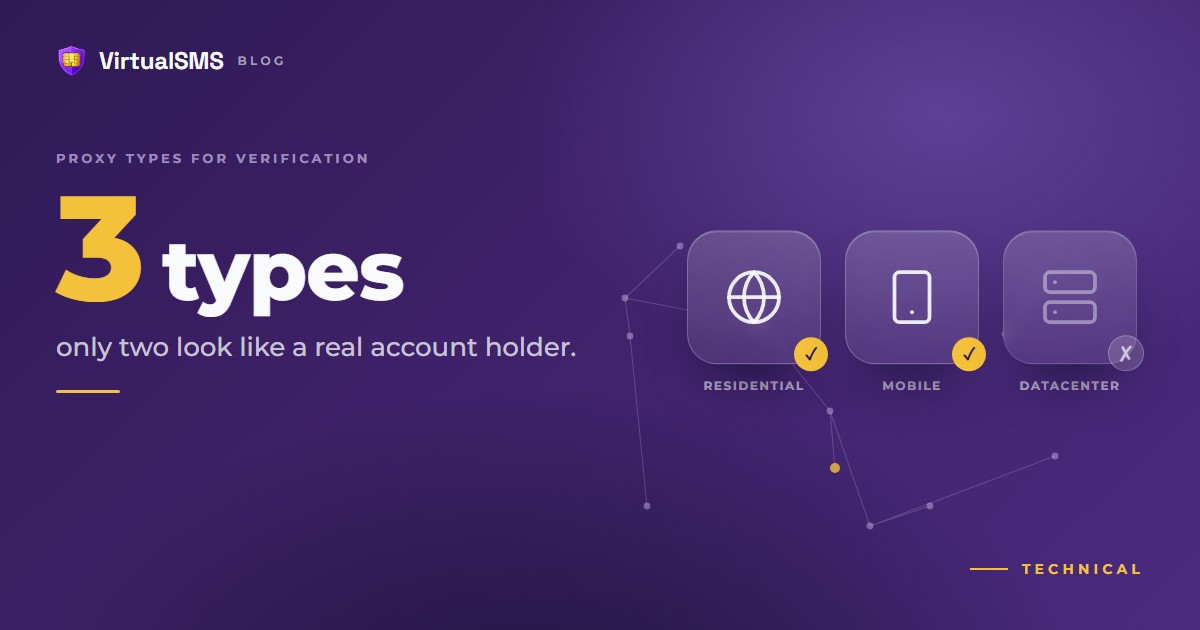
The taxonomy that applies to verification comes from the fraud-scoring side, not the scraping side. IPQualityScore’s connection_type field defines five categories: Residential, Corporate, Education, Mobile, and Data Center. A verification-relevant proxy needs Residential or Mobile, the categories that resemble how a genuine account holder connects. Data Center is the category fraud engines treat as highest risk by default, because almost no real consumer signs up from a hosting provider’s IP range.
MaxMind runs a related database, GeoIP2 Connection Type, whose values top out at Cellular in most clients. Its connection_type field is not the same as hosting or VPN detection, that’s a distinct field, is_hosting_provider. The two get conflated in secondhand summaries, and it matters: a connection-type mismatch and a hosting-provider flag are different signals with different remediation.
The Claims-Adjudication Table
Sourcing this article meant checking every number circulating about proxies and SMS verification against a primary source, and rejecting the ones that don’t have one. Some widely repeated claims are genuinely unverifiable, not because we couldn’t find the source, but because none appears to exist. Two rows below undercut a claim competitors quietly rely on. We’re publishing it anyway, because a sourced “we don’t know” is more citable than an unsourced number that sounds authoritative.
| Claim in circulation | Who asserts it | Primary source? | What is actually documented | Checked |
|---|---|---|---|---|
| ”95-99% pass rate with a matched-country proxy” | Verification-service content (VoidMob and similar) | No | No methodology, sample size, or date on the pages making this claim. Neither confirmed nor contradicted by any primary source located. | 2026-08-10 |
| ”VoIP numbers see 20-40% detection regardless of proxy” | Reseller and content-farm blogs | No | Twilio documents VoIP/landline line type as a risk pattern checked independently of IP. No platform or vendor publishes a percentage tied to this claim. | 2026-08-10 |
| ”Datacenter proxies get detected 25-40% of the time” | Reseller and content-farm blogs | No | IPQualityScore confirms connection type is classified down to “Data Center” with numeric risk bands. No source ties a detection percentage to that category for SMS verification. | 2026-08-10 |
| ”Platforms block OTP registration on IP-country mismatch” | Widespread assumption in proxy-buying communities | Partial | Carousell documents this exact failure. Google references “location,” not “IP address,” for 2FA on existing accounts, not registration. Twilio error 60532 proves the mechanism exists in production. No platform beyond Carousell confirms it for registration. | 2026-08-10 |
| ”A matched proxy makes any number pass verification” | Implied by proxy-for-verification marketing, rarely stated outright | No | Contradicted by Twilio’s line-type documentation: a VoIP or landline number fails that check independent of IP or proxy quality. | 2026-08-10 |
What Platforms Actually Publish
Most of what circulates about IP-country mismatch is reasonable inference, but inference. We searched for platforms saying this about themselves, in their own support documentation, and found one clear match and one near-miss.
Carousell’s help center carries an article titled, verbatim: “I’m seeing ‘Mobile number does not match the IP address’ when I’m trying to sign-up.” That’s as direct as first-party evidence gets: a live consumer marketplace documenting, in its own words, that it checks the number’s implied location against the IP’s and shows an explicit error on mismatch. It’s the single consumer-platform citation behind this article, treated as one confirmed case, not an industry pattern.
Google’s documentation comes close and stops short. Its account-security guidance says, “If we notice something different about how you sign in, like your location, you might not be able to get a verification code through text message.” That sentence says “location,” never “IP address,” and it governs 2FA on an existing account, not registration-time OTP. Treating it as equivalent to Carousell’s statement would be dishonest.
We looked hard for the same statement from WhatsApp, Telegram, Instagram, PayPal, and Amazon. None publish a comparable statement. That absence doesn’t mean the check doesn’t run somewhere in their fraud stack, plenty of fraud logic is deliberately undocumented so it can’t be gamed. It means we can’t cite it, so we don’t. If a code arrives but an account still gets flagged afterward, that’s a different failure, covered in why SMS verification gets blocked.
Practical Guidance
None of this changes what to do, it changes why. If you’re buying a number for a specific country’s platform account, match your proxy’s country to the number’s country whenever a proxy is involved. That’s the one recommendation with real sourcing behind it, from Stripe’s ip_country attribute to Carousell’s documented error.
Check connection type before country, if you have to choose one. IPQualityScore’s bands treat Data Center as highest-risk regardless of geography, a country-matched datacenter IP is still a datacenter IP. Residential or mobile connection types in the right country beat a matched-country datacenter connection too.
Know when a proxy is irrelevant. If the number itself is VoIP or landline, per Twilio’s line-type documentation, no proxy configuration changes that. Fix the number first, whether you’re verifying WhatsApp or anything else running a hard line-type check, using the number-side checklist if a rejection doesn’t match anything above. VirtualSMS activations run on real carrier SIMs, not VoIP, with 95%+ success on real-SIM orders, so the line-type variable is handled before country-matching becomes the remaining lever worth pulling.
Don’t buy a proxy expecting it to fix a rejection you haven’t diagnosed. The industry sells proxies as a universal fix for a problem with at least two independent causes. Diagnose which one you’re facing, carrier or IP mismatch, or line type, before spending on either.
Frequently Asked Questions
Does my proxy’s IP country have to match my phone number’s country for SMS verification?
In most cases, yes, when the platform runs fraud-scoring that checks IP-to-number geographic consistency. Stripe Radar’s ip_country attribute and Twilio’s SNA carrier-mismatch check (error 60532) both document this as a real signal. It won’t help if the number itself fails a separate check, like VoIP line-type rejection.
What does Twilio’s error 60532 actually mean?
Twilio’s Verify documentation defines error 60532, “SNA Potential Dual SIM Detected,” as occurring when the carrier identified from the device’s IP does not match the carrier tied to the number being verified. It proves the carrier-vs-number mismatch check is real, named infrastructure, not that any specific consumer platform runs the identical check.
Can a residential proxy fix a VoIP number rejection?
No. Twilio’s fraud-response guide lists a number’s line type resolving as voip or landline, instead of mobile, as a separate risk signal checked independently of the IP address. A matched-country proxy improves IP-based signals but doesn’t change what a line-type lookup returns for the number itself.
Is the “95-99% pass rate with a matched proxy” claim true?
We couldn’t verify it. No methodology, sample size, or date appears on the pages making this claim, and no primary source, proxy vendor or platform, publishes a comparable figure. Treat it as unverified, not confirmed.
Do platforms like WhatsApp or Google actually publish that they block signups on IP-country mismatch?
Only one: Carousell’s help center has an article titled “Mobile number does not match the IP address” describing exactly this error. Google’s guidance mentions “location” affecting 2FA delivery, not IP address, and only for existing accounts, not registration. No other major platform publishes a comparable statement.
The Bottom Line
Proxy country and type genuinely affect SMS verification success. That’s sourceable, from Stripe’s fraud-scoring attributes to Twilio’s error catalog to Carousell telling its own users about the exact failure. What isn’t sourceable is the confident percentage every reseller attaches to it, most of the numbers in circulation are unverifiable, not wrong exactly, just never documented anywhere.
The honest version: match your proxy’s country to your number’s country when a proxy is involved, prefer residential or mobile connection types over datacenter, and fix the number’s line type first if it’s VoIP, because no proxy touches that check. VirtualSMS sells both halves, real carrier SIMs across 145+ countries and country-matched proxy access, so you’re not guessing which one is broken.
Browse real-SIM verification numbers across 145+ countries → See country-matched proxy options → Full pricing →Sources
- Twilio, Error 60532: SNA Potential Dual SIM Detected, checked 2026-08-10.
- Stripe, Radar supported attributes, checked 2026-08-10.
- MaxMind, minFraud API response documentation, checked 2026-08-10.
- MaxMind, GeoIP2 Connection Type database, checked 2026-08-10.
- IPQualityScore, Proxy Detection API response parameters, checked 2026-08-10.
- Carousell, “Mobile number does not match the IP address” sign-up error, checked 2026-08-10.
- Google, Verify your identity in Google Account sign-in, checked 2026-08-10.
- Twilio, Fraud response guide: validate, checked 2026-08-10.