
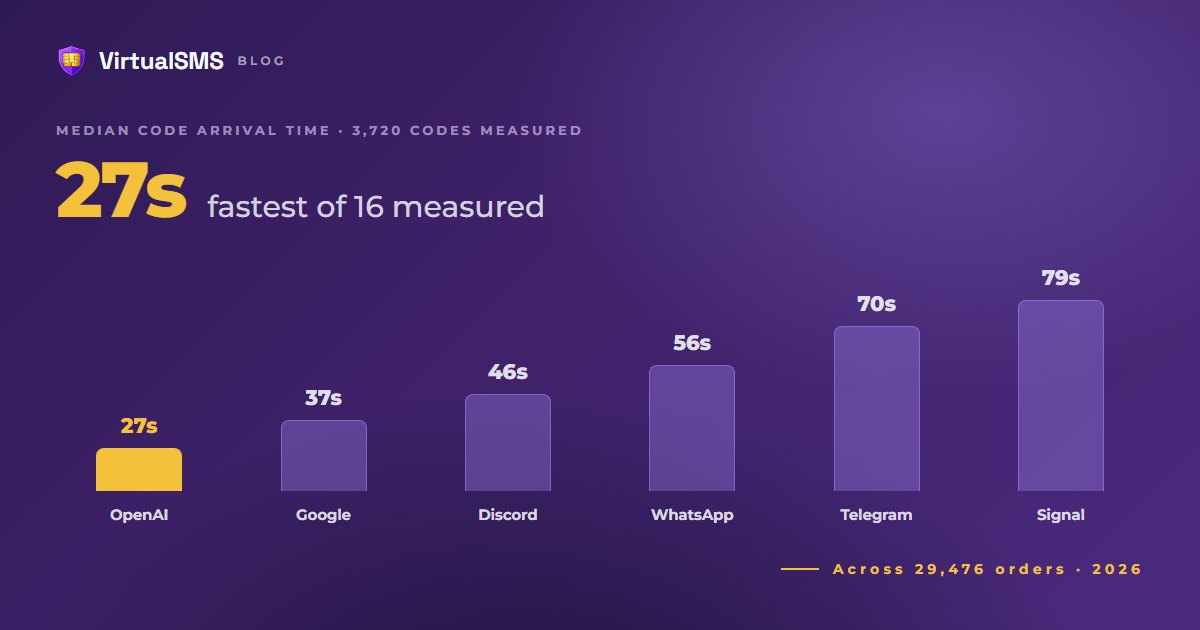
Short answer: Across 29,476 verification orders placed since February 2026, the median SMS verification code arrives in about 47 seconds. Speed depends far more on the platform and country than on any single provider claim: OpenAI codes land in a 27-second median across 36 countries, while Telegram takes 70 seconds and Signal 79. The same platform also varies roughly 2x by country — WhatsApp runs a 44-second median from the United States and 91 seconds from the United Kingdom. The 90th percentile matters more than the median when you are choosing: GCash shows a 22-second median but a 320-second tail. All figures below are measured from real orders, not vendor claims.
Every SMS verification provider claims instant delivery. None of them publish what “instant” actually means, because publishing it would invite the obvious question: instant on which platform, from which country, and how often?
This page answers that with measurement. We timed 29,476 verification orders placed on virtualsms.io between February and September 2026, across 16 platforms and up to 42 countries per platform, and we are publishing the medians, the slow tails, and the sample sizes behind each one. No estimates, no rounding up.
The short version: how long do verification codes take is the wrong question. The right one is which platform, from which country, because those two choices move the number more than anything else.
Median arrival time by platform
Each row below pools every country we measured for that platform. Median means half the codes arrived faster than that time; p90 means 9 in 10 arrived within it.
| Platform | Codes measured | Countries | Median | p90 |
|---|---|---|---|---|
| GCash | 77 | 1 | 22s | 320s |
| OpenAI / ChatGPT | 1,001 | 36 | 27s | 88s |
| Dil Mil | 54 | 5 | 30s | 68s |
| Google / YouTube / Gmail | 284 | 27 | 37s | 140s |
| Vinted | 228 | 10 | 37s | 97s |
| Claude | 60 | 18 | 39s | 103s |
| Discord | 58 | 21 | 46s | 156s |
| Scalapay | 298 | 1 | 54s | 190s |
| TikTok / Douyin | 57 | 14 | 55s | 226s |
| 859 | 41 | 56s | 278s | |
| Bybit | 130 | 7 | 56s | 220s |
| 90 | 16 | 58s | 169s | |
| Instagram / Threads | 149 | 21 | 60s | 236s |
| Telegram | 286 | 42 | 70s | 221s |
| Bumble | 45 | 9 | 73s | 268s |
| Signal | 44 | 20 | 79s | 159s |
Two things stand out.
AI platforms verify fastest. OpenAI at a 27-second median across 36 countries and Claude at 39 seconds are the two quickest platforms in the set. If you are building agent workflows, that matters — and it is one reason the VirtualSMS MCP server exists for exactly that use case.
GCash is the argument for reading both columns. It has the fastest median in the entire table at 22 seconds and one of the worst tails at 320 seconds. A provider quoting only its best median would call GCash its flagship route. In practice it is usually very fast and occasionally very slow.
The same platform is roughly 2x faster in its best country
This is the part almost nobody accounts for. Below are platform-and-country pairs with at least 25 measured codes each.
| Platform | Country | Codes | Median | p90 |
|---|---|---|---|---|
| OpenAI | Indonesia | 33 | 19s | 26s |
| OpenAI | Thailand | 105 | 21s | 96s |
| OpenAI | Brazil | 29 | 23s | 53s |
| OpenAI | Argentina | 29 | 23s | 65s |
| OpenAI | Cameroon | 96 | 24s | 44s |
| OpenAI | Portugal | 36 | 24s | 99s |
| OpenAI | United Kingdom | 80 | 28s | 68s |
| OpenAI | Colombia | 160 | 30s | 128s |
| Google / YouTube / Gmail | United States | 42 | 30s | 104s |
| OpenAI | South Africa | 223 | 31s | 63s |
| Google / YouTube / Gmail | Indonesia | 89 | 31s | 97s |
| OpenAI | France | 38 | 35s | 441s |
| Vinted | Spain | 172 | 37s | 103s |
| OpenAI | Netherlands | 35 | 37s | 57s |
| Google / YouTube / Gmail | United Kingdom | 40 | 41s | 142s |
| United States | 133 | 44s | 121s | |
| Colombia | 36 | 48s | 114s | |
| Poland | 33 | 49s | 290s | |
| Bybit | Thailand | 58 | 50s | 128s |
| Telegram | Colombia | 37 | 52s | 143s |
| Scalapay | Italy | 296 | 54s | 190s |
| Philippines | 58 | 54s | 241s | |
| Instagram / Threads | United States | 60 | 56s | 194s |
| Indonesia | 38 | 56s | 206s | |
| South Africa | 73 | 57s | 301s | |
| United States | 38 | 57s | 119s | |
| Bybit | Malaysia | 29 | 57s | 157s |
| Germany | 37 | 61s | 331s | |
| Google / YouTube / Gmail | Italy | 29 | 67s | 180s |
| Telegram | United Kingdom | 29 | 74s | 182s |
| United Kingdom | 192 | 91s | 533s | |
| Telegram | Germany | 33 | 95s | 482s |
| Bybit | Indonesia | 29 | 108s | 357s |
WhatsApp is the clearest case. A WhatsApp number from the United States shows a 44-second median. A WhatsApp number from the United Kingdom shows 91 seconds — and a 533-second p90, meaning one in ten took nearly nine minutes. Same platform, same product, double the wait.
The same pattern holds for Telegram numbers: 52 seconds from Colombia against 95 seconds from Germany.
This is the practical case against treating country count as a quality signal. Coverage in 145+ countries is real, but measured coverage in the countries you actually need is the thing that changes your outcome. Stock on paper in 180 countries tells you nothing about whether the code arrives.
What the slow tail actually costs you
A long p90 is not an abstraction. If a route has a 533-second p90, roughly one attempt in ten leaves you waiting nine minutes, and most people do not wait — they cancel and buy another number.
That is where the number type matters. A one-time activation is the right tool when the route is fast and predictable: OpenAI from Indonesia at a 19-second median and a 26-second p90 is about as predictable as this gets. When the tail is long and you cannot afford a retry loop, a rented number you keep removes the re-buy entirely — you hold the same number for 1, 7, 30, or 90 days instead of gambling on each new activation.
Either way, an activation that never receives a code auto-refunds within up to 20 minutes without you doing anything. Charging for a code that never arrived is a business model, not an accident, and we have deliberately not built one.
Why the country changes the answer
A verification SMS is not one transmission. It passes through the platform’s queue, an aggregator, the sending carrier, international routing, and finally the receiving carrier’s filter. Most of the variance lives in those last two hops, which is why the same platform behaves so differently depending on where the number is registered. Our breakdown of the SMS delivery stack walks through each hop in detail.
One consequence worth naming: some platforms compare the IP address you are browsing from against the country of the number you are verifying. When those disagree, the verification can be challenged or refused before delivery speed is even relevant. That is the reason country-matched proxies exist alongside the numbers — not as an upsell, but because a fast code delivered to a number the platform has already flagged does not help you. We do not currently have enough measured data to publish a delivery-speed effect from proxy use, so we are not claiming one.
For anyone who would rather not configure any of this, the cloud browser runs a session on a matching-country IP without local setup.
How these numbers were measured
Transparency about method is the difference between data and marketing.
- Source. Completed verification orders on virtualsms.io, 9 February 2026 to 3 September 2026.
- Metric. Seconds from order creation to code receipt.
- Validation. We cross-checked this against the direct SMS-receipt timestamp on the subset of orders where that field is recorded. The medians agree within one second (47s vs 48s) and the 90th percentiles within one second (172s vs 173s). We used the fuller-coverage measure to avoid skewing the sample toward a subset of routes.
- Row thresholds. Platform rows require at least 30 measured codes; platform-and-country rows require at least 25. Thin rows are excluded rather than shown with a caveat.
- Exclusions. Orders under 1 second or over 1 hour are excluded as clock artifacts. Internal test batches are excluded.
- What this is not. These are arrival times for codes that were delivered. This page does not report a success rate, a completion rate, or a failure rate, and the figures should not be read as any of those.
Sample sizes are printed on every row precisely so you can discount the thin ones. A 29-code row is a weaker signal than a 1,001-code row, and we would rather you could tell the difference than present a uniform-looking table.
Frequently Asked Questions
How long should an SMS verification code take to arrive?
Across 29,476 measured orders, the median verification code arrives in about 47 seconds, and 9 in 10 arrive within roughly 3 minutes. Anything past 5 minutes is usually stuck at a destination-carrier spam filter or lost on a cross-border route rather than still in transit. Speed varies by platform: OpenAI averages a 27-second median while Signal averages 79 seconds.
Does the country of the number change how fast the code arrives?
Yes, and by more than most people expect. In our measurements the same platform varies roughly 2x by country. WhatsApp shows a 44-second median on United States numbers and 91 seconds on United Kingdom numbers. OpenAI ranges from 19 seconds on Indonesian numbers to 37 seconds on French and Dutch ones. If speed matters for your use case, the country you pick is the single biggest lever you control.
Why do some verification codes arrive in seconds and others take minutes?
A verification SMS passes through several handoffs: the platform queue, an aggregator, the sending carrier, international routing, and the receiving carrier spam filter. Most delay comes from the last two. That is why the 90th percentile is often five to ten times the median on the same route. A platform can have a fast typical time and still show a long tail.
What is the difference between the median and the 90th percentile here?
The median is the midpoint: half of codes arrive faster, half slower. The 90th percentile (p90) is the slow tail: 9 in 10 codes arrive within that time. GCash illustrates why both matter, showing a 22-second median but a 320-second p90. A low median with a high p90 means it is usually fast but occasionally very slow.
Are these numbers measured or estimated?
Measured. Every figure comes from real completed orders on virtualsms.io between February 2026 and September 2026, timed from order creation to code receipt. Rows shown include a sample size so you can weigh them. This page reports arrival times for codes that were delivered; it is not a success or completion rate.
The Bottom Line
The median verification code takes about 47 seconds. But the useful finding is not the average — it is that the platform and the country you pick move that number by roughly 2x, and that the slow tail is often five to ten times the median on the same route.
Pick the country deliberately. Read the p90, not just the median. And treat any provider quoting a single “instant delivery” figure with the scepticism it has earned, including ours if we ever start.
We will refresh these figures as the sample grows.
Get a verification number → Compare rental options → Full pricing →