If a code was already requested but did not arrive, use the separate verification-code non-arrival diagnostic. It distinguishes documented request, number, account, and delivery restrictions without repeating this compatibility index.
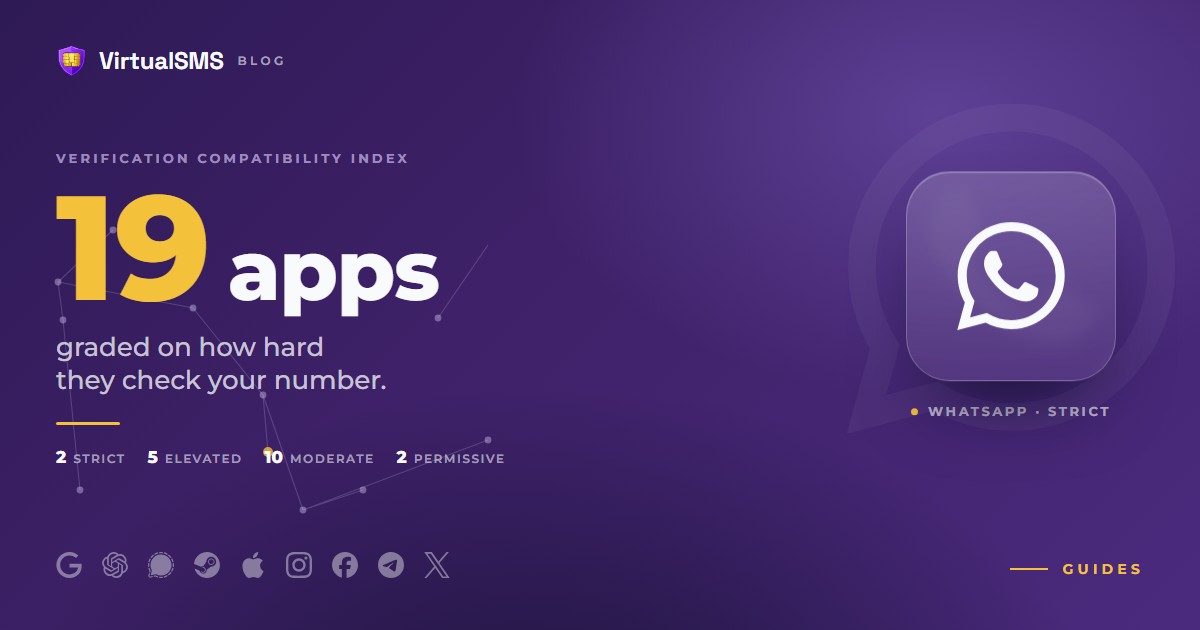
Short answer: This Verification Compatibility Index answers which apps accept virtual numbers, rating 19 of the most-searched apps and platforms on how strict their phone verification is, and which number type passes. WhatsApp and WhatsApp Business sit in the Strict tier with an official, documented ban on VoIP, toll-free, and premium numbers, backed by 6.8 million account removals in the first half of 2025. Google sits in the Elevated tier on a documented-but-unnamed rejection; ChatGPT, Signal, Steam, and Apple ID follow on industry-consensus grounds. Discord and Snapchat are Permissive, with the lightest enforcement at signup. Across every tier, the same pattern holds: real carrier-issued SIM numbers clear checks that VoIP numbers fail more often, and the stricter the platform, the more that distinction matters.
Why phone verification strictness varies by platform
Phone verification is not a single, uniform gate. Some platforms only confirm that a number can receive one SMS. Others run the number through an automated classifier before the verification text is ever sent, checking whether it belongs to a real mobile carrier, a landline, a VoIP service, or a disposable or premium range, and reject it outright if it fails that check.
WhatsApp is the clearest documented case. Its own Help Center lists VoIP, toll-free numbers, premium-rate numbers, and Universal Access Numbers (UAN) among the unsupported phone number types for registration, the only explicit, publicly written ban among the platforms in this index. Meta backs the policy with enforcement at scale: 6.8 million WhatsApp accounts were removed in the first half of 2025 alone.
Underneath most platforms sits the same detection layer, whether or not a policy is published. Twilio’s Lookup “Line Type Intelligence” product, which classifies a number as mobile, landline, or VoIP, went generally available in June 2025 and is one of the tools that powers this kind of cross-platform check. Telesign’s Phone ID and comparable carrier and HLR lookups serve the same function elsewhere. This is now a standard signup-fraud control, not an exotic one, and it is part of why NIST, in Special Publication 800-63B Revision 4 (2025), reclassified SMS and PSTN one-time passcodes as a “restricted authenticator” rather than a fully trusted one. SMS-OTP remains widely used, but the platforms relying on it have gotten more selective about which numbers they accept.
That tightening is not happening in a vacuum. Residential proxies became the dominant attack infrastructure behind SMS fraud in 2025, according to Prelude’s analysis of more than 205 million authentication requests, which found an 11.83% fraud rate across that sample. For a deeper look at the detection stack platforms run to catch numbers like that, see How Platforms Detect Virtual Phone Numbers in 2026.
That is what this index measures: not how good VirtualSMS is at anything, but how strict each platform’s own verification gate is, and which number type clears it. One clarification before the index: VirtualSMS provides real carrier-issued SIM numbers, not the VoIP-type numbers most of the tiers below are built to catch. The Official Policy column below marks the difference between a documented rule and an inferred one; the two are not equally strong evidence, and this index treats them differently.
The Index
Verification strictness reflects how likely a non-carrier (VoIP-type) number is to be rejected or flagged at verification. Strict means a real carrier SIM matters most; Permissive means enforcement is lightest at signup. Official Policy marks whether that grade comes from a platform’s own published rule or from industry-consensus evidence; see the Methodology section for what each label requires.
| Service | Verification strictness | Official Policy | Works best with | Why |
|---|---|---|---|---|
| Strict | ✅ Documented | Real carrier SIM | Written ban on VoIP, toll-free, and premium numbers; 6.8M accounts purged H1 2025 | |
| WhatsApp Business (API) | Strict | ✅ Documented | Real carrier SIM | Same policy, enforced earlier via automated line-type checks at onboarding |
| Google / Gmail | Elevated | ✅ Documented* | Carrier SIM (VoIP usually rejected) | Official rejection message; VoIP providers confirm their own ranges get blocked |
| ChatGPT / OpenAI | Elevated | ⚠ Industry consensus | Carrier SIM (VoIP usually rejected) | No published policy, but VoIP rejections at signup are widely and consistently reported |
| Signal | Elevated | ⚠ Industry consensus | Carrier SIM (VoIP often flagged) | Registration requires an SMS/call-capable number; VoIP ranges widely reported to fail |
| Steam | Elevated | ⚠ Industry consensus | Carrier SIM (VoIP often flagged) | Steam Guard phone verification gates trading and Marketplace access; VoIP ranges reported to fail more often |
| Apple ID | Elevated | ⚠ Industry consensus | Carrier SIM (VoIP often flagged) | Two-factor “trusted phone number” requirement enforced more tightly than plain signup |
| Moderate | ⚠ Industry consensus | Carrier SIM preferred | No published VoIP ban; enforcement reported as inconsistent | |
| Moderate | ⚠ Industry consensus | Carrier SIM preferred | Same Meta stack as Instagram; no dedicated policy documented | |
| Telegram | Moderate | ⚠ Industry consensus | Carrier SIM preferred | Historically tolerant; mid-2025 crackdown tightened delivery and CAPTCHA checks |
| X / Twitter | Moderate | ⚠ Industry consensus | Carrier SIM preferred | Aggressive bot detection overall; number flags commonly reported, no published VoIP policy |
| TikTok | Moderate | ⚠ Industry consensus | Carrier SIM preferred | Enforcement reported to be tightening; no official policy published |
| Tinder | Moderate | ⚠ Industry consensus | Carrier SIM preferred | Dating platforms have a strong incentive to filter suspicious number types |
| Discord | Permissive | ⚠ Industry consensus | Carrier SIM or VoIP | Most forgiving platform in this index at signup |
| Snapchat | Permissive | ⚠ Industry consensus | Carrier SIM or VoIP | Light enforcement at verification, similar to Discord |
| Uber | Moderate | ⚠ Industry consensus | Carrier SIM preferred | No published VoIP ban; driver-side onboarding reported stricter than rider signup |
| Airbnb | Moderate | ⚠ Industry consensus | Carrier SIM preferred | Phone verification is part of broader identity checks; host accounts face heavier scrutiny |
| Moderate | ⚠ Industry consensus | Carrier SIM preferred | No published VoIP ban; verification triggered by anti-spam/anti-bot systems, not applied universally | |
| Amazon | Moderate | ⚠ Industry consensus | Carrier SIM preferred | Verification is security-focused rather than KYC-driven; enforcement reported as inconsistent |
Google’s rejection message is official but does not name VoIP explicitly; graded Documented on the combination of an official rejection and independent confirmation from VoIP providers themselves. See Methodology.
“Best country” per service is intentionally left out of this version; see the Methodology note below.
Per-service phone verification breakdown
WhatsApp: Strict
WhatsApp is the only platform in this index with a written, public ban.
- Its Help Center lists VoIP, toll-free numbers, premium-rate numbers, and Universal Access Numbers (UAN) among the unsupported phone number types for registration.
- Meta enforces the policy at scale: 6.8 million WhatsApp accounts were removed in the first half of 2025 alone.
- The block applies at registration, not just after suspicious activity, so a VoIP number typically fails before an account exists.
Related reading: How to Buy a Virtual Number for WhatsApp Verification, WhatsApp Number Banned? Why It Happens and How to Fix It
Need a carrier number that matches? → View WhatsApp numbers
WhatsApp Business (API): Strict
The Business API inherits WhatsApp’s consumer ban and enforces it earlier in the funnel.
- Same underlying VoIP, toll-free, and premium ban as consumer WhatsApp.
- Onboarding runs the number through an automated line-type check, the category of check Twilio’s Lookup Line Type Intelligence (GA since June 2025) is built for, so a VoIP number can be rejected before the SMS step.
- Matters most when scaling past the default 20-number account limit, where every new line needs to clear verification cleanly the first time.
Related reading: WhatsApp 20-Number Limit: How to Scale Past It in 2026
Need a carrier number that matches? → View WhatsApp numbers
Google / Gmail: Elevated
Google’s rejection is official, though it stops short of naming VoIP directly.
- The error for an ineligible number (“This phone number cannot be used for verification”) is Google’s own, not inferred.
- It doesn’t name VoIP explicitly, but third-party VoIP providers themselves confirm Google blocks their number ranges.
- That combination, an official-but-unnamed rejection paired with independent confirmation from the VoIP side, is why Google is graded Documented with a footnote rather than an explicit ban.
Related reading: How to Create a Gmail Account Without a Phone Number
Need a carrier number that matches? → View Google numbers
ChatGPT / OpenAI: Elevated
ChatGPT and OpenAI accounts sit in the Elevated tier: VoIP number rejections at signup are widely and consistently reported, even though OpenAI has never published a VoIP policy.
- No official VoIP policy exists for ChatGPT or OpenAI accounts.
- VoIP number rejections at signup are widely and consistently reported by users.
- The pattern is consistent with the same category of automated line-type checks used industry-wide, rather than a platform-specific rule unique to OpenAI.
Related reading: Why ChatGPT / OpenAI Rejects Your Phone Number, and the Real Fix
This pattern is not just a human-signup problem. AI agents that verify accounts autonomously hit the same VoIP-detection wall; see AI Agents Need Real Phone Numbers for how that plays out.
Need a carrier number that matches? → View ChatGPT numbers
Signal: Elevated
Signal sits in the Elevated tier: its registration flow requires a number that can receive an SMS or automated call, and VoIP-type numbers are widely and consistently reported to fail that step, even though Signal has never published an explicit VoIP ban.
- No official VoIP-specific policy exists; Signal’s registration step simply requires a number that can receive an SMS or call, and the same category of carrier line-type detection used industry-wide appears to sit behind that check.
- User and community reports describe VoIP and virtual numbers failing Signal registration more often than plain signup on lighter-tier platforms in this index, consistent with the detection mechanics documented elsewhere here.
- Signal ties every account permanently to one phone number with no separate username, so getting the number right at registration matters more than on platforms where a number change later is straightforward.
Need a carrier number that matches? → View Signal numbers
Steam: Elevated
Steam sits in the Elevated tier: phone verification (Steam Guard Mobile) is required to unlock trading and Community Market access, and that step is widely reported to be stricter than a plain signup check.
- No official VoIP-specific ban is published, but Steam Guard’s phone-verification step is required to lift trade holds and access the Community Market, functions Valve treats as fraud-sensitive.
- User and community reports describe some VoIP and virtual number ranges failing Steam’s verification step more often than real carrier numbers, consistent with the same carrier line-type detection used across other Elevated-tier platforms in this index.
- A number that fails partway through verification can leave an account in a trade-hold state, a heavier cost than a failed signup on a lighter-tier platform.
Need a carrier number that matches? → View Steam numbers
Apple ID: Elevated
Apple ID sits in the Elevated tier: two-factor authentication requires a “trusted phone number” that can receive an SMS or call, and that requirement is enforced more consistently than a typical social-app signup check.
- No official VoIP-specific ban is published for Apple ID, but the two-factor authentication flow requires a phone number that can reliably receive a verification code, and enforcement around that requirement is reported as tighter than plain account creation.
- Apple’s own support documentation asks for a number that can receive texts or calls without naming VoIP directly, the same “official-but-unnamed” evidentiary pattern seen elsewhere in this index, though not independently confirmed enough here to grade Documented.
- Because a trusted phone number can also be used for account recovery, a number that reliably receives codes matters more for Apple ID than for platforms where phone verification is a one-time signup step.
Need a carrier number that matches? → View Apple numbers
Instagram: Moderate
Instagram sits in the Moderate tier: no VoIP ban is published, and enforcement is reported as inconsistent, a VoIP number might pass on one signup and get flagged on the next.
- Meta has never published a VoIP ban for Instagram specifically, unlike its explicit WhatsApp policy.
- No independently confirmed line-type-block pattern exists for Instagram the way it does for Google.
- Instagram runs on the same underlying Meta anti-abuse stack as WhatsApp, but without WhatsApp’s written rule behind it.
Related reading: Buy an Indonesia Instagram Number
Need a carrier number that matches? → View Instagram numbers
Facebook: Moderate
Facebook sits in the Moderate tier, the same grade as Instagram, running Meta’s shared anti-abuse stack without a dedicated VoIP policy of its own.
- No published VoIP-specific ban exists for Facebook, the same evidentiary position as Instagram rather than WhatsApp’s documented one.
- Facebook draws on the same category of carrier and line-type detection common across large platforms; what differs from Instagram is the volume of public reporting, not the underlying mechanism.
- A real carrier SIM is preferred and a VoIP number is not guaranteed to fail, the same practical guidance that applies to Instagram.
Related reading: Verify Facebook Without Your Personal Phone Number
Need a carrier number that matches? → View Facebook numbers
Telegram: Moderate
Telegram has historically been the most VoIP-tolerant of the major messaging platforms.
- No published VoIP policy exists; enforcement has traditionally been lighter than other Moderate-tier platforms.
- A mid-2025 registration crackdown tightened CAPTCHA and SMS-delivery checks, corroborated independently by more than one automation vendor.
- The tightening moved Telegram from consistently easy toward moderate; it remains less strict than any Strict-tier platform, but “easy” is no longer a safe assumption.
Related reading: Virtual Number for Telegram Verification: What Actually Works in 2026, How to Verify Telegram Without Your Real Phone Number
Need a carrier number that matches? → View Telegram numbers
X / Twitter: Moderate
X (Twitter) sits in the Moderate tier: no published VoIP policy exists, but the platform’s aggressive anti-bot posture makes number flags a commonly reported outcome at signup.
- No official VoIP-specific policy exists for X; the Moderate grade reflects consistent user reporting rather than a documented rule.
- X’s broader anti-spam and anti-bot enforcement is well known, and platforms at this evidence tier typically lean on the same category of carrier and line-type lookup used industry-wide, even without confirmation specific to X.
- Enforcement is reported as inconsistent: some VoIP numbers clear signup cleanly while others get flagged immediately, the same evidentiary pattern seen with Instagram and Facebook.
Need a carrier number that matches? → View X numbers
TikTok: Moderate
TikTok sits in the Moderate tier: enforcement is reported to be tightening, but no official VoIP policy has been published.
- No published VoIP-specific ban exists for TikTok, the same evidentiary position as Instagram and Facebook.
- User reports describe number-type checks getting stricter over time rather than pointing to a single documented rule change.
- TikTok allows multiple accounts per device, but each new account still needs its own number to clear signup.
Need a carrier number that matches? → View TikTok numbers
Tinder: Moderate
Tinder sits in the Moderate tier: no published VoIP policy exists, but dating platforms carry a strong structural incentive to filter suspicious number types.
- No official VoIP-specific ban exists for Tinder; the Moderate grade reflects industry-consensus reasoning rather than a documented rule.
- Dating apps face heavier catfishing and bot-account pressure than most consumer platforms, an incentive that tends to correlate with tighter number-type filtering industry-wide.
- Enforcement details are not independently confirmed for Tinder specifically, so a VoIP number is a risk rather than a guaranteed pass.
Need a carrier number that matches? → View Tinder numbers
Discord: Permissive
Discord sits in the Permissive tier: it is the most forgiving platform in this index at signup, though phone verification can still be required later for specific servers or features.
- No published VoIP-specific ban exists for Discord, and user reports describe number-type enforcement as light at initial signup.
- Some servers and features (age-gated content, higher rate limits) can trigger a stricter phone-verification step later, even when the original signup passed easily.
- Because that later check is unpredictable, a real carrier SIM removes the guesswork for anyone planning to stay verified long-term.
Need a carrier number that matches? → View Discord numbers
Snapchat: Permissive
Snapchat sits in the Permissive tier, similar to Discord, with light enforcement reported at verification.
- No published VoIP-specific ban exists for Snapchat, and user reports describe verification as easier to clear than Moderate-tier platforms.
- Light enforcement at signup does not mean permanent immunity; platforms can and do revisit number-type checks after the fact.
- A real carrier SIM is not required to clear Snapchat’s checks today, but it removes the risk of a future policy tightening catching an existing account.
Need a carrier number that matches? → View Snapchat numbers
Uber: Moderate
Uber sits in the Moderate tier: phone verification is required at signup for both riders and drivers, but no published VoIP-specific ban exists and enforcement is reported as inconsistent.
- No official VoIP policy exists for Uber; a VoIP number often clears rider signup without issue, while driver-side onboarding, which carries heavier identity verification, is reported to be stricter.
- Uber ties a phone number closely to trip and payment history, so a number change later in the account lifecycle is reported to be more friction-heavy than on lighter-tier platforms.
- Enforcement is reported as inconsistent across regions, the same evidentiary pattern seen with Instagram and Facebook elsewhere in this index.
Need a carrier number that matches? → View Uber numbers
Airbnb: Moderate
Airbnb sits in the Moderate tier: phone verification is required to book or host, but no published VoIP-specific ban exists.
- No official VoIP-specific ban is published for Airbnb; phone verification is part of its broader identity-verification flow rather than a dedicated number-type check.
- Host accounts face heavier identity scrutiny than guest accounts, an incentive structure similar to the trust-and-safety reasoning that applies to dating platforms elsewhere in this index.
- Enforcement details are not independently confirmed for VoIP specifically, so a VoIP number is a risk rather than a guaranteed pass, the same practical guidance that applies to Tinder.
Need a carrier number that matches? → View Airbnb numbers
LinkedIn: Moderate
LinkedIn sits in the Moderate tier: phone verification is commonly triggered for new or flagged accounts, but no published VoIP-specific ban exists.
- No official VoIP-specific policy is published for LinkedIn; phone verification is typically triggered by its own anti-spam and anti-bot systems rather than applied uniformly at every signup.
- User reports describe enforcement as inconsistent, similar to the pattern seen with X and TikTok elsewhere in this index.
- A professional-network account carries reputational weight for many users, a reason to prefer a stable carrier number even where enforcement is currently light.
Need a carrier number that matches? → View LinkedIn numbers
Amazon: Moderate
Amazon sits in the Moderate tier: phone verification here is mostly about account security rather than KYC, and enforcement is reported as inconsistent.
- No official VoIP-specific ban is published for Amazon; a VoIP number often clears initial account creation.
- Amazon may request reverification later for suspicious activity or order disputes, at which point a documented, consistent number is worth having on file.
Need a carrier number that matches? → View Amazon numbers
Methodology (read this before trusting a single row)
This index grades every platform on two separate things: how strict its verification actually is (the Verification strictness column) and how strong the evidence behind that grade is (the Official Policy column). The two are not the same, and conflating them is the fastest way to overstate confidence in a row that is really an inference.
✅ Documented means the platform has published a written policy, or issues an official rejection response tied specifically to a VoIP-type number. Only WhatsApp, WhatsApp Business, and Google carry this label here. Google’s carries a footnote because its rejection message does not name VoIP explicitly; it is graded Documented on the combination of an official rejection and independent confirmation from VoIP providers.
⚠ Industry consensus means no VoIP-specific policy has been published. The strictness tier assigned in that case is built from three things: detection mechanics documented to exist across the industry (carrier and HLR line-type lookups, tools like Twilio Lookup Line Type Intelligence and Telesign Phone ID); consistent, widely reported user experiences with the platform; and named-source news events where available, such as Telegram’s mid-2025 registration tightening. None of it is internal VirtualSMS order data. Production order volume per service and per country hasn’t cleared an internal data-quality bar yet, so it is not used in this version.
What’s not in v1: “best country per service.” That needs production-order data broken down by service and country, the exact number this index doesn’t use yet. A v1.1 update will add a “best country” column once that data clears review, held to the same evidence standard applied here.
What Verification strictness is not measuring: it is not a claim about VirtualSMS’s own verification success rate. It rates how strict each platform’s own verification gate is, industry-wide, independent of which service someone uses to obtain the number.
Cheapest-per-number is the wrong question to ask once a platform sits in the Strict or Elevated tier. A number that costs less but gets rejected at signup costs more once the failed attempt is counted. That is the reason a “Works best with” column exists here at all, not just a strictness column.
FAQ
Which apps are hardest to verify with a virtual number? WhatsApp and the WhatsApp Business API sit in the Strict tier, the only platforms in this index with an explicit written ban on VoIP, toll-free, and premium numbers. Google follows in the Elevated tier on an official, if VoIP-unnamed, rejection message. ChatGPT, Signal, Steam, and Apple ID round out the Elevated tier on industry-consensus grounds, with no official rejection language published for any of them.
Does WhatsApp actually block VoIP numbers? Yes. WhatsApp’s own Help Center lists VoIP, toll-free, and premium-rate numbers among the unsupported number types for registration. It is the only platform in this index with a documented ban rather than an inferred one, and Meta backs it with real enforcement: 6.8 million WhatsApp accounts removed in the first half of 2025.
Can I use a VoIP number for Telegram or Discord? Often, yes; they sit in the Moderate and Permissive tiers, the most forgiving in this index. But “often” is not “always”: Telegram tightened its registration checks in a mid-2025 crackdown, and any platform can flag a number later even if it accepted it at signup. A real carrier SIM removes that uncertainty.
Why does my phone number get rejected during signup even on platforms without a public VoIP policy? Most platforms use some form of carrier or line-type lookup (the same category of tool as Twilio’s Line Type Intelligence or Telesign’s Phone ID) even when the policy behind it isn’t published. The number is classified as mobile, landline, or VoIP before the SMS ever sends, and VoIP numbers fail that check more often, even without a named ban. That’s what the Official Policy column in the index distinguishes: a written rule versus an inferred one.
What’s the actual difference between a VoIP number and a real SIM number for verification? A real carrier SIM is issued by an actual mobile network (a German number runs on a network like Telekom, Vodafone, or O2, for example) and returns “mobile” on a carrier line-type lookup. A VoIP number is internet-routed and returns “VoIP” on that same lookup, the exact signal platforms like WhatsApp use to reject it before sending the code.
Will this index change over time?
Yes, and it should. Platform policies shift (Telegram tightened in 2025; Meta’s enforcement scale keeps moving), and this page’s dateModified will be bumped whenever a tier or Official Policy grade changes. A v1.1 update is already planned to add a “best country per service” column once VirtualSMS’s own production verification data clears an internal accuracy check.
Sources
- WhatsApp: VoIP/toll-free/premium number ban. WhatsApp Help Center, “How to register your phone number.” faq.whatsapp.com/684051319521343
- Meta removed 6.8M WhatsApp accounts in H1 2025 (16.8M including Facebook). Meta Newsroom, “New WhatsApp Tools and Tips to Beat Messaging Scams,” 2025-08-05. about.fb.com/news/2025/08/new-whatsapp-tools-tips-beat-messaging-scams
- NIST SP 800-63B Revision 4 (2025) reclassified SMS/PSTN OTP as a “restricted authenticator” (Sec. 3.2.9, with PSTN out-of-band requirements in Sec. 3.1.3.3-3.1.3.4). NIST Digital Identity Guidelines, published 2025-07-31. nvlpubs.nist.gov/nistpubs/SpecialPublications/NIST.SP.800-63B-4.pdf
- Twilio Lookup “Line Type Intelligence”: general availability, June 24, 2025. twilio.com/en-us/blog/products/launches/generally-available-lookup-line-type-intelligence
- Prelude 2025 SMS Fraud Report: residential proxies as dominant attack infrastructure, 11.83% fraud rate across 205M+ authentication requests analyzed. prelude.so/blog/2025-sms-fraud-report